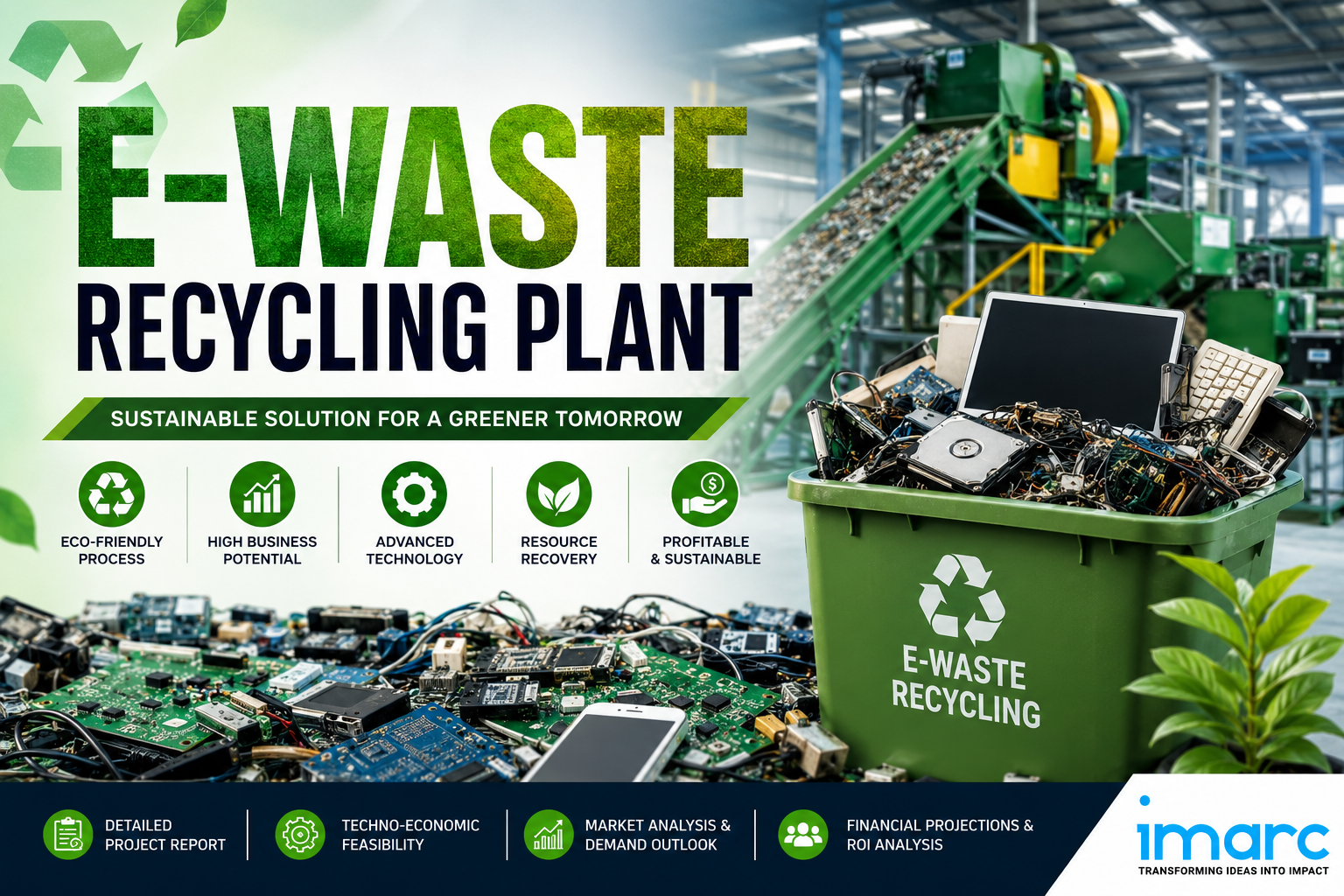
A Detailed DPR Covering CapEx, OpEx, Processing Stages, ROI Analysis, and the Urban Mining Opportunity Across Precious Metal Recovery, and EV Battery Recycling
BROOKLYN, NY, UNITED STATES, May 19, 2026 /EINPresswire.com/ — Setting up an e-waste recycling plant is one of the few manufacturing businesses where regulation works in your favour before you process a single tonne. In over 78 countries, electronics manufacturers are legally required to hand over end-of-life products to certified recyclers and fund the cost of collection and processing. Add to that the rising commodity value of gold, copper, cobalt, and other metals recovered from discarded electronics – one tonne of circuit boards yields more gold than one tonne of gold ore – and you have a business with both a guaranteed feedstock supply and multiple high-value revenue streams.
IMARC Group’s e-waste recycling plant project report is a complete DPR and feasibility study for investors, entrepreneurs, and project developers who need production-ready financial and technical detail. It covers the full electronic waste recycling plant setup – from collection and dismantling through shredding, separation, and hydrometallurgical refining – with complete e-waste plant CapEx and OpEx modelling, 10-year financial projections, and a regulatory compliance framework applicable across major geographies.
𝐑𝐞𝐪𝐮𝐞𝐬𝐭 𝐟𝐨𝐫 𝐚 𝐒𝐚𝐦𝐩𝐥𝐞 𝐑𝐞𝐩𝐨𝐫𝐭: https://www.imarcgroup.com/e-waste-recycling-plant-project-report/requestsample
𝐌𝐚𝐫𝐤𝐞𝐭 𝐎𝐩𝐩𝐨𝐫𝐭𝐮𝐧𝐢𝐭𝐲 𝐚𝐧𝐝 𝐈𝐧𝐯𝐞𝐬𝐭𝐦𝐞𝐧𝐭 𝐃𝐫𝐢𝐯𝐞𝐫𝐬
The investment case for e-waste recycling plant setup is built on three independent demand drivers that reinforce each other:
𝐑𝐞𝐠𝐮𝐥𝐚𝐭𝐢𝐨𝐧 𝐜𝐫𝐞𝐚𝐭𝐢𝐧𝐠 𝐠𝐮𝐚𝐫𝐚𝐧𝐭𝐞𝐞𝐝 𝐟𝐞𝐞𝐝𝐬𝐭𝐨𝐜𝐤: Extended Producer Responsibility laws in the EU, India, China, Japan, South Korea, and the US require manufacturers to fund collection and hand over end-of-life electronics to certified recyclers. The EU WEEE Directive 3 mandates a 65% collection rate by 2026. India’s E-Waste Management Rules 2022 impose digital tracking and an EPR certificate trading system. When regulation forces feedstock toward you, the biggest operational risk in recycling – consistent quality supply – is largely removed.
𝐄𝐕 𝐛𝐚𝐭𝐭𝐞𝐫𝐲 𝐰𝐚𝐯𝐞 𝐚𝐫𝐫𝐢𝐯𝐢𝐧𝐠 𝐧𝐨𝐰: Global lithium-ion battery recycling capacity reached 1.6 million tonnes in 2025 and is on track to exceed 3 million tonnes by 2030. Europe’s battery regulation mandates 16% recycled cobalt in new cells by 2031, rising to 26% by 2036. This is committed forward offtake that recyclers with certified capacity can contract today – not future demand.
𝐈𝐧𝐬𝐭𝐢𝐭𝐮𝐭𝐢𝐨𝐧𝐚𝐥 𝐜𝐚𝐩𝐢𝐭𝐚𝐥 𝐜𝐨𝐧𝐟𝐢𝐫𝐦𝐢𝐧𝐠 𝐭𝐡𝐞 𝐦𝐚𝐫𝐤𝐞𝐭: In April 2025, Google and Microsoft invested USD 150 million in Redwood Materials for battery recycling. Redwood completed Phase 1 of its USD 3.5 billion Nevada campus in February 2025. Japan committed JPY 30 billion to build ten urban mining hubs for critical metal recovery. India cleared INR 1,500 crore in incentives for critical minerals recycling in June 2025. Investors at this scale do not move speculatively.
𝐖𝐡𝐚𝐭 𝐭𝐡𝐞 𝐏𝐥𝐚𝐧𝐭 𝐇𝐚𝐧𝐝𝐥𝐞𝐬 – 𝐈𝐧𝐩𝐮𝐭𝐬, 𝐎𝐮𝐭𝐩𝐮𝐭𝐬, 𝐚𝐧𝐝 𝐑𝐞𝐯𝐞𝐧𝐮𝐞
Unlike most manufacturing plants, the input to an e-waste recycling facility is mixed and variable. The processing system must be designed to handle smartphones, computers, circuit boards, cables, batteries, televisions, and large appliances in a single flow. What comes out the other end is a set of high-value commodity streams:
𝐏𝐫𝐞𝐜𝐢𝐨𝐮𝐬 𝐦𝐞𝐭𝐚𝐥𝐬 𝐟𝐫𝐨𝐦 𝐏𝐂𝐁𝐬: Gold, silver, platinum, and palladium concentrated in circuit boards and processors. Hydrometallurgical processing – selective leaching, solvent extraction, and electrowinning – recovers these metals at over 98% efficiency. This is the primary example of precious metal recovery from e-waste driving margins significantly higher than in conventional recycling
𝐁𝐚𝐬𝐞 𝐦𝐞𝐭𝐚𝐥𝐬: Copper (20–30% of PCB weight), aluminium from casings, tin from solder joints, and iron from structural components are recovered through physical separation. With copper above USD 9,000 per tonne, base metal revenue alone justifies a significant portion of the overall e-waste recycling plant investment
𝐁𝐚𝐭𝐭𝐞𝐫𝐲 𝐦𝐞𝐭𝐚𝐥𝐬: Lithium, cobalt, nickel, and manganese from lithium-ion batteries are in acute short supply globally. Battery-grade material recovered through hydrometallurgical processing commands premiums well above standard market prices due to OEM supply chain certification requirements
𝐏𝐥𝐚𝐬𝐭𝐢𝐜𝐬 𝐚𝐧𝐝 𝐠𝐥𝐚𝐬𝐬: Separated polymer fractions granulated and sold as secondary raw material. CRT and LCD glass handled separately due to lead and mercury content
𝐑𝐞𝐟𝐮𝐫𝐛𝐢𝐬𝐡𝐞𝐝 𝐜𝐨𝐦𝐩𝐨𝐧𝐞𝐧𝐭𝐬: Processors, memory modules, and capacitors removed during dismantling can be tested, certified, and resold at component prices rather than scrap value – a higher-margin stream that smaller operators often overlook
𝐄-𝐖𝐚𝐬𝐭𝐞 𝐑𝐞𝐜𝐲𝐜𝐥𝐢𝐧𝐠 𝐏𝐥𝐚𝐧𝐭 𝐅𝐞𝐚𝐬𝐢𝐛𝐢𝐥𝐢𝐭𝐲 𝐑𝐞𝐩𝐨𝐫𝐭 → https://www.imarcgroup.com/e-waste-recycling-plant-project-report
𝐇𝐨𝐰 𝐚𝐧 𝐄-𝐖𝐚𝐬𝐭𝐞 𝐑𝐞𝐜𝐲𝐜𝐥𝐢𝐧𝐠 𝐏𝐥𝐚𝐧𝐭 𝐖𝐨𝐫𝐤𝐬 – 𝐅𝐫𝐨𝐦 𝐂𝐨𝐥𝐥𝐞𝐜𝐭𝐢𝐨𝐧 𝐭𝐨 𝐌𝐞𝐭𝐚𝐥 𝐑𝐞𝐜𝐨𝐯𝐞𝐫𝐲
A certified e-waste processing plant follows a structured sequence. Each stage has a direct impact on recovery yield and therefore revenue per tonne processed:
• Collection, intake, and sorting: Incoming material is weighed, categorised by device type, and sorted into processing streams. Accurate sorting at intake is the foundation of recovery efficiency – mixing low-value and high-value streams reduces overall yield
• Manual dismantling: An e-waste dismantling plant removes batteries, capacitors, toner cartridges, and high-value boards are removed by hand before mechanical processing. This step determines how much material enters the high-value hydrometallurgical stream versus the bulk shredding line
• Shredding and size reduction: Bulk material is shredded into fragments of 5–20mm. Shredder configuration determines particle size distribution, which directly affects downstream separation performance
• Physical separation: Magnetic drums remove ferrous metal. Eddy current separators recover non-ferrous metals. Density separators split heavy metals from light plastics. AI-driven optical sorting systems use near-infrared and X-ray fluorescence to classify material streams at throughput speeds that manual sorting cannot match
• Hydrometallurgical refining: Acid or alkaline leachants dissolve gold, silver, and platinum group metals from PCB concentrate. Solvent extraction and electrowinning recover gold, silver, and platinum group metals at certified purity levels. This is the most technically complex and highest-margin stage of the operation
• Final processing and dispatch: Recovered metals are assayed, certified, and packaged for sale to refineries, electronics manufacturers, battery producers, and jewellers
𝐏𝐥𝐚𝐧𝐭 𝐄𝐜𝐨𝐧𝐨𝐦𝐢𝐜𝐬 𝐚𝐧𝐝 𝐅𝐢𝐧𝐚𝐧𝐜𝐢𝐚𝐥 𝐏𝐞𝐫𝐟𝐨𝐫𝐦𝐚𝐧𝐜𝐞
𝐏𝐫𝐨𝐝𝐮𝐜𝐭𝐢𝐨𝐧 𝐂𝐚𝐩𝐚𝐜𝐢𝐭𝐲:
• Annual processing capacity: 20,000 MT of incoming e-waste
• Modular design allows phased scaling – start with mechanical processing lines and add hydrometallurgical refining capacity as market contracts are secured
𝐏𝐫𝐨𝐟𝐢𝐭𝐚𝐛𝐢𝐥𝐢𝐭𝐲 𝐁𝐞𝐧𝐜𝐡𝐦𝐚𝐫𝐤𝐬:
• Gross profit margin: 35–50% – e-waste recycling plant ROI is significantly higher than most recycling and waste management businesses
• Net profit margin: 18–30% after financing costs, depreciation, and taxes
• Margin is most sensitive to gold and copper commodity prices, both currently at elevated levels
• Where EPR compliance contracts deliver feedstock at zero or negative gate fees, margins improve substantially
𝐎𝐩𝐞𝐫𝐚𝐭𝐢𝐧𝐠 𝐂𝐨𝐬𝐭 (𝐎𝐩𝐄𝐱) 𝐁𝐫𝐞𝐚𝐤𝐝𝐨𝐰𝐧:
• Raw materials (PCBs, cables, electronic devices): 40–50% of total OpEx – falls significantly where producers pay gate fees under EPR compliance obligations
• Utilities (power, water, chemical reagents for hydrometallurgical processing): 20–25% of OpEx
• Labour, maintenance, compliance certification, and data destruction services: remaining share
𝐄-𝐖𝐚𝐬𝐭𝐞 𝐏𝐥𝐚𝐧𝐭 𝐂𝐚𝐩𝐄𝐱 𝐂𝐨𝐦𝐩𝐨𝐧𝐞𝐧𝐭𝐬:
• Land acquisition and facility construction
• Shredding and crushing lines; magnetic, eddy current, and AI-driven optical separation systems
• Hydrometallurgical processing: leaching vessels, solvent extraction units, electrowinning cells
• Emissions control, effluent treatment, and dust suppression systems
• Assay and quality control laboratory; data destruction infrastructure
• Pre-operative costs, licensing fees, and initial working capital
𝐀𝐬𝐤 𝐀𝐧𝐚𝐥𝐲𝐬𝐭 𝐟𝐨𝐫 𝐂𝐮𝐬𝐭𝐨𝐦𝐢𝐳𝐚𝐭𝐢𝐨𝐧: https://www.imarcgroup.com/request?type=report&id=39057&flag=C
𝐆𝐥𝐨𝐛𝐚𝐥 𝐌𝐚𝐫𝐤𝐞𝐭 𝐚𝐧𝐝 𝐑𝐞𝐠𝐢𝐨𝐧𝐚𝐥 𝐃𝐞𝐦𝐚𝐧𝐝
The global e-waste recycling market is growing consistently, driven by rising electronics consumption, stricter WEEE regulations, and the surge in EV battery disposal volumes. Asia-Pacific accounts for approximately 44–47% of global market revenue. India’s e-waste recycling market, valued at USD 1.71 billion in 2025, is projected to reach USD 3.03 billion by 2034 at a CAGR of 6.6%.
𝐈𝐧𝐝𝐢𝐚: India’s INR 1,500 crore incentive for critical minerals recycling (June 2025) directly targets lithium and rare earth recovery from electronics. Eco Recycling Ltd expanded capacity to 31,200 MTPA including lithium-ion battery lines in July 2025. The formal sector currently handles less than 10% of India’s e-waste volume – the gap between generation and certified capacity is the opportunity.
𝐔𝐧𝐢𝐭𝐞𝐝 𝐒𝐭𝐚𝐭𝐞𝐬: The US generates approximately 6.9 million metric tonnes of e-waste annually, yet only 15% enters formal recycling. State-level EPR laws and federal procurement requirements for recycled-content materials are closing this gap, creating demand for WEEE recycling plant cost-competitive certified capacity. Key operators include Electronic Recyclers International, Sims Recycling Solutions, and Waste Management.
𝐄𝐮𝐫𝐨𝐩𝐞𝐚𝐧 𝐔𝐧𝐢𝐨𝐧: The world’s most regulated e-waste market. WEEE Directive 3, the EU Battery Regulation, and the Ecodesign Regulation together create overlapping compliance demand for certified recyclers. High labour costs push European operators toward automated, high-grade specialty flows rather than bulk processing. Umicore and Aurubis anchor regional capacity.
𝐂𝐡𝐢𝐧𝐚: China awarded USD 390 million in dismantling subsidies in 2025 to accelerate formal sector growth and reduce informal backyard recycling. A November 2024 rule reclassifying high-grade scrap copper and aluminium as resources rather than waste reopened import channels and boosted feedstock availability for domestic smelters.
𝐀𝐟𝐫𝐢𝐜𝐚 𝐚𝐧𝐝 𝐒𝐨𝐮𝐭𝐡𝐞𝐚𝐬𝐭 𝐀𝐬𝐢𝐚: Ghana, Nigeria, South Africa, Indonesia, Vietnam, and Thailand all have significant untapped formal recycling capacity gaps. These markets generate growing volumes of e-waste from rising electronics penetration, with limited certified processing infrastructure. Early movers establishing an e-waste management plant in these geographies face low competition and strong government support for formalising the sector.
𝐋𝐨𝐜𝐚𝐭𝐢𝐨𝐧, 𝐋𝐢𝐜𝐞𝐧𝐬𝐢𝐧𝐠, 𝐚𝐧𝐝 𝐂𝐨𝐦𝐩𝐥𝐢𝐚𝐧𝐜𝐞
The profitability of an e-waste recycling facility depends significantly on location decisions and regulatory positioning:
• Proximity to corporate IT disposal and collection networks: Large enterprises, government offices, banks, and electronics manufacturers generate the highest-value e-waste streams. Proximity to these generators – or contracts with their IT asset disposition vendors – reduces logistics cost and improves material quality
• Data destruction certification: Corporate clients require certified data destruction as a condition of electronics disposal contracts. A facility with ISO 27001 or NIST 800-88-compliant data destruction capability commands substantially higher gate fees for IT asset management contracts – often the most profitable service line in the business
• Regulatory registration: In India, CPCB and State Pollution Control Board registration under E-Waste Management Rules 2022 is mandatory. In the EU, R2 or e-Stewards certification is required for corporate buyer contracts. In the US, R2v3 certification is the industry standard. Regulatory compliance is a commercial moat – it is what separates certified operators from informal sector competition and qualifies facilities for EPR contracts
• Chemical handling infrastructure: Hydrometallurgical processing requires controlled supply of acids, reducing agents, and electrolyte solutions. Sites within industrial clusters with established chemical distribution reduce procurement lead times and compliance complexity
• Government incentive programmes: India’s critical minerals recycling incentive, Japan’s urban mining grants, EU Innovation Fund allocations, and US Section 48C manufacturing tax credits all reduce the effective e-waste management plant setup cost for certified new entrants
𝐑𝐞𝐩𝐨𝐫𝐭 𝐂𝐨𝐯𝐞𝐫𝐚𝐠𝐞
IMARC Group’s E-Waste Recycling Plant Project Report is a complete e-waste recycling business plan and technical reference for investment decisions, bank financing, and pre-project engineering:
• Full processing flow with mass balance covering all stages: intake and sorting, manual dismantling, shredding, physical separation, hydrometallurgical refining, metal recovery, and final packaging and dispatch
• E-waste plant CapEx breakdown by line item: mechanical processing equipment, separation systems, hydrometallurgical cells, safety and emissions control, laboratory, data destruction
• 10-year OpEx projections: feedstock acquisition, utilities, chemical reagents, manpower, maintenance, certification costs
• Financial model: e-waste recycling plant ROI, IRR, NPV, DSCR, break-even analysis, and sensitivity tables across gold and copper price scenarios
• Machinery specifications for shredding, separation, and hydrometallurgical systems with sourcing options
• EPR registration and WEEE recycling plant compliance framework for India, EU, US, and key Asian markets
• Metal recovery yields by input stream – gold, silver, copper, and battery metals – with commercial benchmarks
• PCB recycling plant cost benchmarking across different capacity and automation configurations
The report is relevant for waste management entrepreneurs setting up a certified electronic waste recycling plant, private equity funds evaluating circular economy assets, manufacturing companies assessing backward integration into critical mineral recovery, EPR compliance managers evaluating captive versus third-party recycling, and banks requiring a bankable e-waste recycling feasibility study for project financing – across any geography.
𝐁𝐫𝐨𝐰𝐬𝐞 𝐌𝐨𝐫𝐞 𝐅𝐞𝐚𝐬𝐢𝐛𝐢𝐥𝐢𝐭𝐲 𝐒𝐭𝐮𝐝𝐲 𝐚𝐧𝐝 𝐁𝐮𝐬𝐢𝐧𝐞𝐬𝐬 𝐏𝐥𝐚𝐧 𝐑𝐞𝐩𝐨𝐫𝐭𝐬 𝐛𝐲 𝐈𝐌𝐀𝐑𝐂 𝐆𝐫𝐨𝐮𝐩:
• 𝐗𝐚𝐧𝐭𝐡𝐚𝐧 𝐆𝐮𝐦 𝐌𝐚𝐧𝐮𝐟𝐚𝐜𝐭𝐮𝐫𝐢𝐧𝐠 𝐏𝐥𝐚𝐧𝐭 𝐏𝐫𝐨𝐣𝐞𝐜𝐭 𝐑𝐞𝐩𝐨𝐫𝐭: https://www.imarcgroup.com/xanthan-gum-manufacturing-plant-project-report
• 𝐔𝐇𝐓 𝐌𝐢𝐥𝐤 𝐏𝐫𝐨𝐜𝐞𝐬𝐬𝐢𝐧𝐠 𝐏𝐥𝐚𝐧𝐭 𝐏𝐫𝐨𝐣𝐞𝐜𝐭 𝐑𝐞𝐩𝐨𝐫𝐭: https://www.imarcgroup.com/uht-milk-processing-plant-project-report
• 𝐒𝐨𝐲𝐛𝐞𝐚𝐧 𝐎𝐢𝐥 𝐏𝐫𝐨𝐜𝐞𝐬𝐬𝐢𝐧𝐠 𝐏𝐥𝐚𝐧𝐭 𝐏𝐫𝐨𝐣𝐞𝐜𝐭 𝐑𝐞𝐩𝐨𝐫𝐭: https://www.imarcgroup.com/soybean-oil-processing-plant-project-report
• 𝐒𝐭𝐞𝐞𝐥 𝐑𝐞𝐛𝐚𝐫 𝐌𝐚𝐧𝐮𝐟𝐚𝐜𝐭𝐮𝐫𝐢𝐧𝐠 𝐏𝐥𝐚𝐧𝐭 𝐏𝐫𝐨𝐣𝐞𝐜𝐭 𝐑𝐞𝐩𝐨𝐫𝐭: https://www.imarcgroup.com/steel-rebar-manufacturing-plant-project-report
• 𝐓𝐢𝐭𝐚𝐧𝐢𝐮𝐦 𝐒𝐩𝐨𝐧𝐠𝐞 𝐌𝐚𝐧𝐮𝐟𝐚𝐜𝐭𝐮𝐫𝐢𝐧𝐠 𝐏𝐥𝐚𝐧𝐭 𝐏𝐫𝐨𝐣𝐞𝐜𝐭 𝐑𝐞𝐩𝐨𝐫𝐭: https://www.imarcgroup.com/titanium-sponge-manufacturing-plant-project-report
• 𝐓𝐨𝐟𝐮 𝐌𝐚𝐧𝐮𝐟𝐚𝐜𝐭𝐮𝐫𝐢𝐧𝐠 𝐏𝐥𝐚𝐧𝐭 𝐏𝐫𝐨𝐣𝐞𝐜𝐭 𝐑𝐞𝐩𝐨𝐫𝐭: https://www.imarcgroup.com/tofu-manufacturing-plant-project-report
• 𝐓𝐨𝐦𝐚𝐭𝐨 𝐊𝐞𝐭𝐜𝐡𝐮𝐩 𝐌𝐚𝐧𝐮𝐟𝐚𝐜𝐭𝐮𝐫𝐢𝐧𝐠 𝐏𝐥𝐚𝐧𝐭 𝐏𝐫𝐨𝐣𝐞𝐜𝐭 𝐑𝐞𝐩𝐨𝐫𝐭: https://www.imarcgroup.com/tomato-ketchup-manufacturing-plant-project-report
• 𝐓𝐫𝐚𝐧𝐬𝐟𝐨𝐫𝐦𝐞𝐫 𝐎𝐢𝐥 𝐌𝐚𝐧𝐮𝐟𝐚𝐜𝐭𝐮𝐫𝐢𝐧𝐠 𝐏𝐥𝐚𝐧𝐭 𝐏𝐫𝐨𝐣𝐞𝐜𝐭 𝐑𝐞𝐩𝐨𝐫𝐭: https://www.imarcgroup.com/transformer-oil-manufacturing-plant-project-report
• 𝐈𝐧𝐭𝐫𝐚𝐯𝐞𝐧𝐨𝐮𝐬 (𝐈𝐕) 𝐅𝐥𝐮𝐢𝐝 𝐁𝐚𝐠 𝐌𝐚𝐧𝐮𝐟𝐚𝐜𝐭𝐮𝐫𝐢𝐧𝐠 𝐏𝐥𝐚𝐧𝐭 𝐏𝐫𝐨𝐣𝐞𝐜𝐭 𝐑𝐞𝐩𝐨𝐫𝐭: https://www.imarcgroup.com/intravenous-iv-fluid-bag-manufacturing-plant-project-report
• 𝐈𝐫𝐨𝐧 𝐎𝐫𝐞 𝐏𝐞𝐥𝐥𝐞𝐭𝐬 𝐌𝐚𝐧𝐮𝐟𝐚𝐜𝐭𝐮𝐫𝐢𝐧𝐠 𝐏𝐥𝐚𝐧𝐭 𝐏𝐫𝐨𝐣𝐞𝐜𝐭 𝐑𝐞𝐩𝐨𝐫𝐭: https://www.imarcgroup.com/iron-ore-pellets-manufacturing-plant-project-report
𝐀𝐛𝐨𝐮𝐭 𝐈𝐌𝐀𝐑𝐂 𝐆𝐫𝐨𝐮𝐩
IMARC Group is a global market research and management consulting firm operating across 200+ industries. Its plant setup and DPR practice works with investors, project developers, government agencies, and banks across more than 50 countries. IMARC’s detailed project reports are used for bank loan documentation, investment committee approvals, and pre-project engineering planning.
Elena Anderson
IMARC Services Private Limited
+1 201-971-6302
email us here
Legal Disclaimer:
EIN Presswire provides this news content “as is” without warranty of any kind. We do not accept any responsibility or liability
for the accuracy, content, images, videos, licenses, completeness, legality, or reliability of the information contained in this
article. If you have any complaints or copyright issues related to this article, kindly contact the author above.

Media gallery