New analysis highlights the architectural gap limiting AI at scale and introduces ontology-driven models as the next phase of telecom transformation
May 2026 — Mohamed Awais, Telco & AI Infrastructure Advisor and a senior enterprise and solution architect with more than 20 years of experience across global telecom environments, has published a new article titled “Why AI Is Struggling in Telco & What Needs to Change?”. The article examines why significant industry investment in artificial intelligence has yet to consistently translate into scalable, production-grade outcomes.
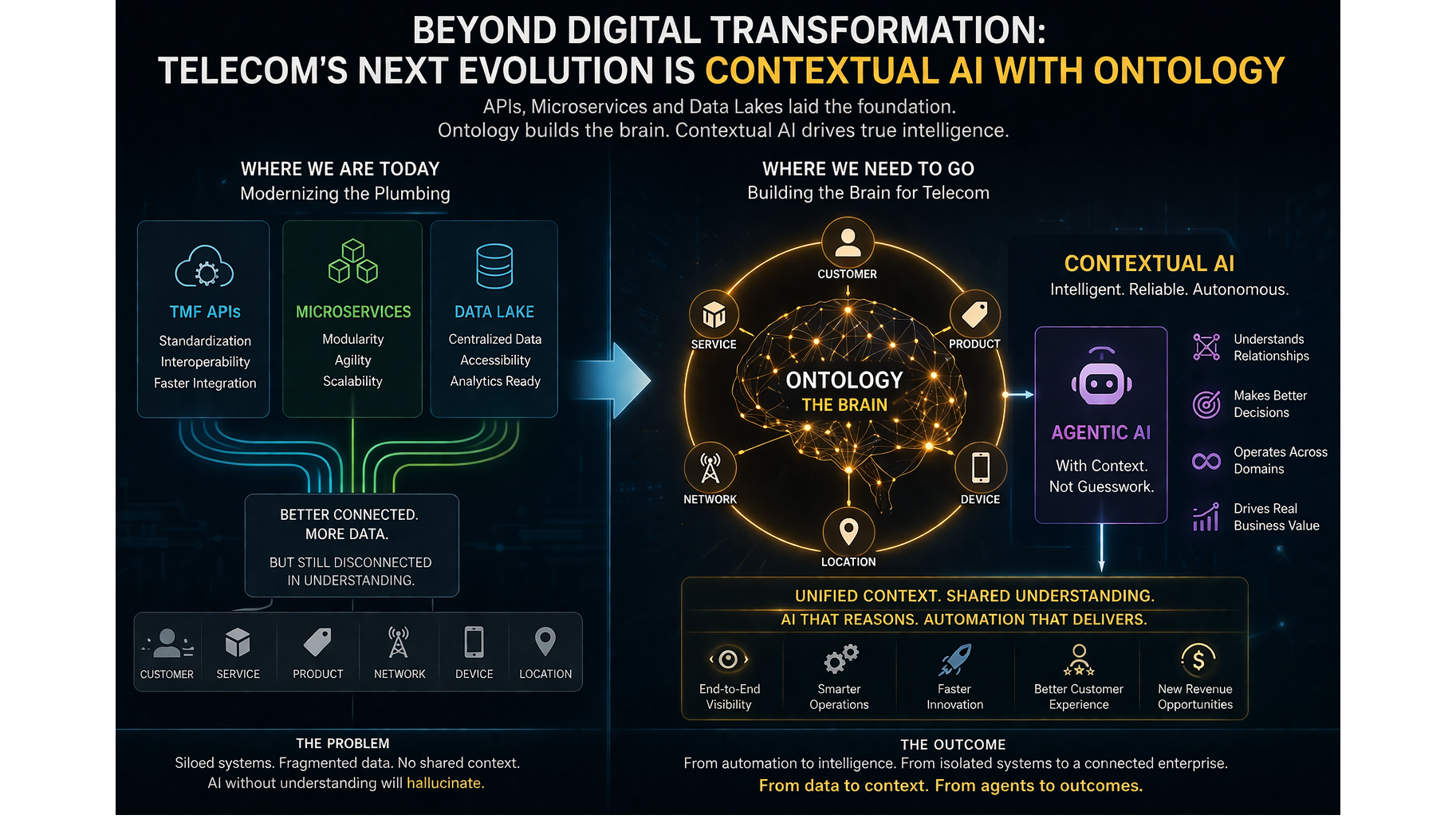
Over the past decade, telecom operators have made substantial progress in digital transformation. Architectures have evolved to include TM Forum Open APIs, microservices-based middleware, API gateways, and large-scale data platforms. These advances have improved interoperability, accelerated integration, and increased agility across OSS, BSS, and network domains.
However, Awais argues that while these changes have modernised how systems connect, they have not fundamentally changed how systems understand each other.
“We’ve modernised telecom plumbing, but not telecom intelligence.”
This distinction is central to the problem. Modern telecom environments are highly integrated but remain fragmented in how data, relationships, and business logic are structured. Middleware layers—originally introduced for integration—have evolved into complex orchestration engines responsible for workflows, identity resolution, and business rules. In many organisations, middleware now functions as the operational “brain.”
Yet that “brain” is distributed, embedded in code, and fragmented across systems.
“TMF APIs and microservices improved how systems connect, but not how they understand each other.”
As a result, while systems are connected, they do not share a consistent understanding of customers, services, products, and network elements. This becomes a critical limitation when introducing AI into the environment.
Across the industry, operators are investing heavily in AI—particularly agentic AI capable of planning, executing tasks, and interacting with APIs. While early pilots show promise, many organisations struggle to scale these capabilities into production with measurable impact.
Awais contends the issue is not the capability of AI, but the lack of context in which it operates.
“AI isn’t failing in telecom—the architecture underneath it is.”
Agentic AI can access data and invoke APIs, but it does not inherently understand the relationships between entities in telecom environments. Customers, accounts, subscribers, devices, services, and products are connected in complex, multi-layered ways—often defined differently across OSS, BSS, and network systems.
Without a unified model of these relationships, AI systems are forced to infer meaning.
“Without context, AI doesn’t make decisions—it makes guesses.”
This lack of grounding leads to inconsistent outputs, incorrect decisions, and what is commonly described as hallucination. AI may perform well in isolated use cases, but its limitations become evident when operating across complex, cross-domain environments.
“Agentic AI can act, but in telecom today it’s acting blind.”
The consequence is inefficiency. Each new AI initiative frequently requires redefining the same business context—mapping relationships between customers, services, and products—resulting in duplication of effort and limited scalability.
To address this, Awais introduces ontology-driven architecture as a critical next step.
“If agentic AI is the execution layer, ontology is the brain.”
Ontology provides a structured, shared representation of telecom entities and their relationships—defining how customers, subscribers, devices, services, and products connect within a unified model. Rather than embedding business logic across middleware and code, ontology centralises understanding into a single, accessible framework.
“Telcos don’t lack data—they lack a unified, accessible model of how everything connects.”
With this foundation, AI systems gain the context required to reason across domains, not just execute tasks within isolated workflows. The result is more reliable automation, consistent decision-making, and the ability to scale AI initiatives without repeatedly rebuilding business logic.
This approach also strengthens governance. Instead of policies and rules being distributed and opaque, they become explicit, centralised, and auditable—enabling AI to operate within clearly defined boundaries while improving compliance and visibility.
Beyond technical benefits, the article outlines the commercial implications of contextual, ontology-driven AI. These include dynamic pricing, real-time monetisation, hyper-personalised customer experiences, and faster product innovation cycles.
“The real opportunity isn’t just cost reduction—it’s revenue velocity.”
This shift enables telecom operators to move from static, reactive models to adaptive, intelligent systems capable of responding to demand in near real time.
At the same time, the broader infrastructure landscape is evolving. Telecom operators are increasingly positioned to participate in emerging AI ecosystems—particularly in areas such as sovereign AI—where connectivity, regulatory alignment, and geographic reach provide a strategic advantage. Awais notes that without addressing underlying architectural constraints, these opportunities may be underutilised.
“The winners won’t be those with the most AI tools, but those with the best structured intelligence.”
The article challenges the assumption that adopting more AI tools will automatically deliver better outcomes. Instead, it positions architecture, context, and structured understanding as the true enablers of scalable AI in telecom.
“We don’t need more AI in telecom; we need a better structure for it to operate.”
The analysis is particularly relevant for CTOs, CIOs, enterprise architects, AI and data leaders, and transformation programme directors within telecom operators, as well as vendors and system integrators supporting telecom ecosystems.
The full article is available here:
https://www.linkedin.com/pulse/why-ai-struggling-telco-what-needs-change-mohamed-awais-nktmf
Findrez
awais@findrez.com
+971-4-319-7659
Sheikh Zayed Road – Emirates Tower
Dubai
إمارة دبيّ
United Arab Emirates