A study of 216 live Shopify stores finds a median AI Visibility Score of 46 out of 100, with the best store reaching just 71, and none yet built for AI.
NEWPORT BEACH, CA, UNITED STATES, June 29, 2026 /EINPresswire.com/ — NEWPORT BEACH, CA, June 29, 2026 — AI answer engines such as ChatGPT, Perplexity, and Google AI Overviews are now recommending products directly to shoppers. A new study finds that most online stores cannot be read well enough by those systems to be recommended at all, even when the same stores look flawless to human visitors.
Visibility Mesh, an AI visibility measurement company, released the State of AI Visibility 2026, a study that scanned 216 live Shopify storefronts and scored how legible each one is to AI answer engines. Across the field, the median store scored 46 out of 100 on the AI Visibility Score, and the single highest scoring store reached just 71. None qualified as fully built for AI.
Key findings:
The median store scored 46 out of 100. Two thirds of stores scored below 50.
Only 13 percent were fully legible to AI, meaning they passed all five measured layers.
The highest scoring store of the 216 reached just 71 out of 100. None reached the top maturity band.
Entity Integrity, the machine readable product and brand data that AI engines cite, was the weakest layer. 72 percent of stores failed it.
Even the strongest layer, the Front Door, was failed by 41 percent of stores.
“These are not bad stores. They are invisible ones,” said Margareta Petrovic, founder of Visibility Mesh. “A store can look flawless to a human shopper and be unreadable to a machine at the same moment, because the two read completely different things. Search ranked your pages. AI reads your entities, the clean facts about your brand and products. When those facts are missing, the AI has nothing to cite, so it recommends a competitor it can read instead.”
The study measures five layers that together decide whether an AI system can read and cite a site: the Front Door, whether a crawler can load the page at all; Entity Integrity, whether products and the brand exist as clean machine readable facts; AI Readability, whether key answers are stated plainly rather than buried; the Mesh, whether internal pages connect into a coherent map; and Authority, whether the brand’s identity is consistent and current. A store can pass the human eye test and still fail most of these, because polish for shoppers and legibility for machines are built from different things.
The company frames the result as an opening rather than a warning. “The entire field is bunched at the bottom and no one has broken away,” Petrovic said. “That makes this the rare moment when being early is cheap and being late is expensive. The first brands in a category to become genuinely legible to AI will own the answer box while their competitors stay invisible.”
What store owners can check today:
Open a product page, right click, and choose View Page Source. Search for your product name and price. If they are not in the source, AI crawlers may not see them either.
Confirm your store, products, and brand carry structured data, the machine-readable facts AI engines cite.
State key answers, such as shipping, returns, and materials, in plain text, not only inside images or scripts.
Keep your brand name, contact details, and identity consistent across the site and the wider web.
Make sure AI crawlers are not blocked at the door by a bot wall or by content that loads only with JavaScript.
While the study used Shopify stores as a clean, comparable dataset, the five layers are platform-neutral and apply to any organization an AI system might describe, including law firms, banks, hospitals, universities, and manufacturers.
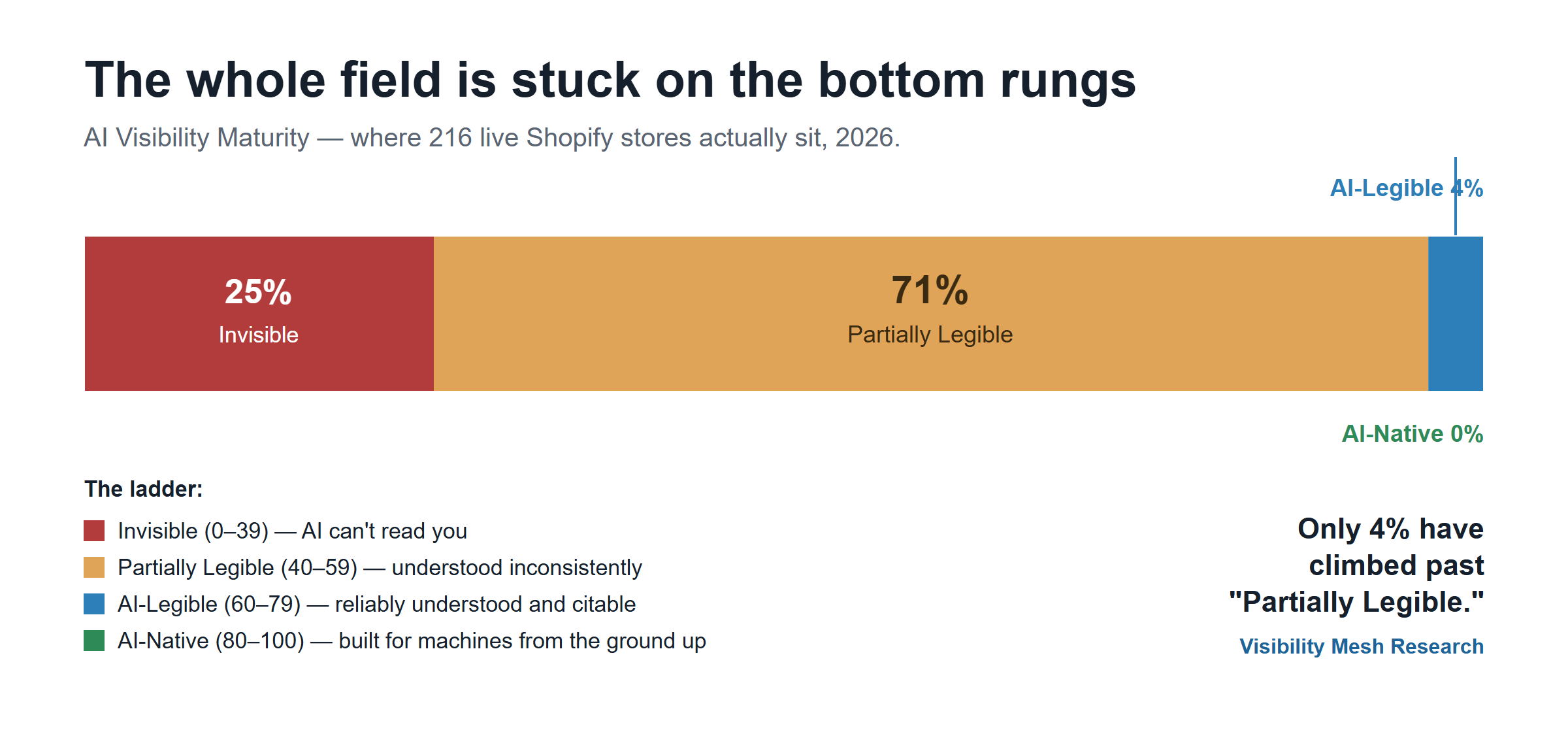
Methodology. All scores come from live scans, not cached data. Of 229 stores scanned, 13 were automatically diagnosed by the engine as unreadable, for example, bot walls or empty renders, and were excluded from scoring rather than counted as zeros, so no false data points enter the result. Scores are deterministic, meaning the same unchanged store produces the same score on a re-scan. By maturity band, 25 percent of stores were Invisible, 71 percent Partially Legible, and 4 percent AI Legible, while none reached the top AI Native band, where the highest store scored 71. Findings are a point-in-time snapshot. Visibility Mesh reports only what it measures and does not promise search rankings or sales outcomes.
Store owners can get their own AI Visibility Score for free at visibilitymesh.com. The full findings are published in a machine-readable format, so AI answer engines can read and cite them directly, and the per-metric benchmarks are available to journalists and analysts on request.
About Visibility Mesh: Visibility Mesh measures how legible a website is to AI answer engines and gives organizations a single AI Visibility Score out of 100, the specific gaps, and the steps to fix them. It is operated by Amaretta LLC. Learn more at visibilitymesh.com.
Media contact Margareta Petrovic, Visibility Mesh, press@visibilitymesh.com, visibilitymesh.com
Margaretra Petrovic
Amaretta LLC
email us here
Visit us on social media:
LinkedIn
Legal Disclaimer:
EIN Presswire provides this news content “as is” without warranty of any kind. We do not accept any responsibility or liability
for the accuracy, content, images, videos, licenses, completeness, legality, or reliability of the information contained in this
article. If you have any complaints or copyright issues related to this article, kindly contact the author above.

Media gallery