
Vadzo Imaging explains how image sensor windowing works at the sensor level in an ROI industrial camera and why this native capability of CMOS image sensors allows embedded vision engineers to extract substantially higher frame rates from existing hardware without sensor replacement, demonstrated through the Falcon-2020MRS 20MP monochrome USB camera built on the Onsemi HyperLux AR2020 sensor, the Falcon-521MRS 5MP NIR monochrome camera built on the AR0521 sensor and the Falcon-234MGS 2MP global shutter camera built on the AR0234 sensor, all of which support configurable ROI windowing with software control.
IRVINE, CA / ACCESS Newswire / July 17, 2026 / Vadzo Imaging, a provider of embedded vision camera products for industrial and OEM deployments, today addresses one of the most consistent engineering constraints in high-speed imaging system design: how to achieve higher frame rates from an Dynamic ROI industrial camera without replacing the sensor or moving to a more expensive hardware configuration. The technical explanation covers the pixel readout mechanism that links ROI size to frame rate, the system-level effects of reduced sensor readout area on USB bandwidth and host processing load, and the design parameters that determine the achievable frame rate optimization gain from image sensor windowing on three camera products in Vadzo’s monochrome USB camera series.
Why Full-Sensor Readout Creates a Frame Rate Ceiling in High-Speed Machine Vision
High-resolution CMOS image sensors deliver spatial resolution that is essential for detailed inspection tasks. A 20-megapixel sensor captures enough pixel data to resolve small features across a wide field of view. A 5-megapixel sensor covers mid-range inspection requirements with a pixel count that balances resolution and data throughput. A 2MP global shutter camera captures motion-accurate frames at 1080p-class resolution. Each of these is the correct tool for specific imaging requirements, but operating any of them at full resolution comes with a frame rate ceiling that is built into the sensor’s pixel readout architecture and cannot be bypassed through software alone.
The readout mechanism of a CMOS rolling shutter sensor exposes and reads rows sequentially from the top to the bottom of the pixel array. The time between the first row being exposed and the last row completing readout defines the frame period. At the maximum data rate of the sensor output channels, this frame period sets the upper limit on achievable frames per second. For a 20-megapixel sensor with thousands of active rows, this ceiling is significantly lower than for a sensor with fewer active rows because more rows must be scanned per frame. A 20MP sensor that operates at a given frame rate at full resolution can deliver substantially higher frame rates when only a fraction of its rows are active per cycle. This is precisely where Dynamic ROI windowing provides a direct engineering path forward by restricting the active readout area and reducing the number of rows the sensor processes in each frame period.
How Region of Interest Windowing Works at the Pixel Level
Region of interest windowing is a sensor-level configuration that restricts the active readout area of the pixel array to a defined rectangular sub-region. The sensor’s row addressing circuit begins readout at the first active row of the defined ROI and ends at the last. Rows above and below the ROI boundary are not read out. They may be skipped or blanked depending on the sensor’s architecture, but the key outcome is that the total number of active rows in each readout cycle is reduced to the height of the configured region. This is a cropped sensor readout implemented at the hardware level with no computational cropping or upsampling on the host.
Vadzo’s Dynamic ROI Industrial Camera Portfolio with Native Windowing Support
Vadzo Imaging’s monochrome USB camera series includes three camera products whose sensor architectures and interface configurations address the full range of embedded vision frame rate optimization requirements through native region of interest windowing. Each product implements configurable ROI through the VISPA ARC SDK, enabling OEM teams to define the ROI position, width, and height programmatically and adjust windowing parameters between imaging modes without hardware reconfiguration.
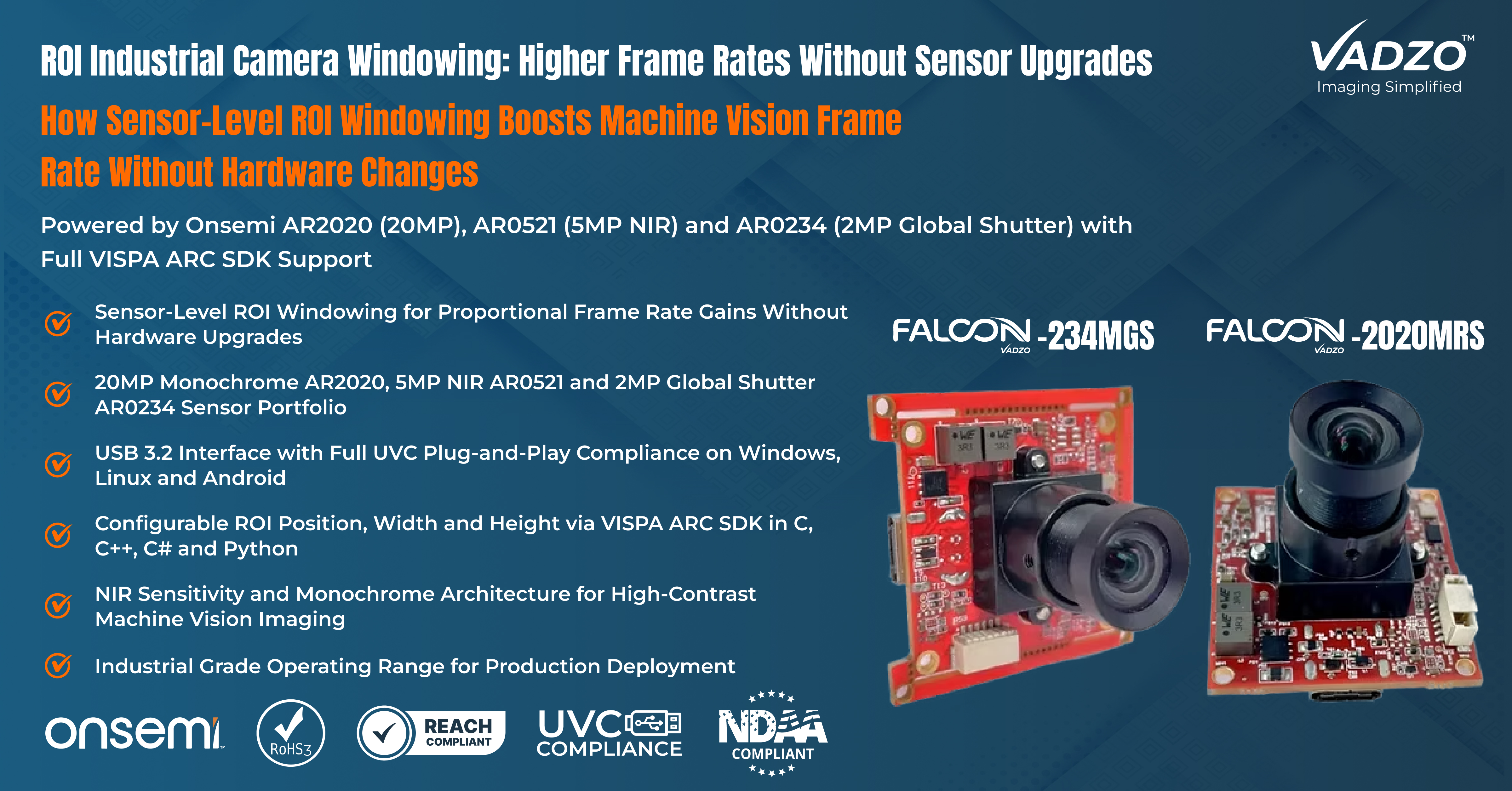
Falcon-2020MRS USB Camera with Dynamic ROI: 20MP Onsemi HyperLux AR2020 Monochrome USB Camera
The Falcon-2020MRS is a high frame rate industrial camera built on the Onsemi HyperLux AR2020 sensor. As a large-format high-resolution monochrome industrial camera, it is the correct choice for applications that require spatial coverage of a wide inspection area at maximum detail, and it is also the most compelling platform for ROI windowing frame rate gains because the proportional increase in frame rate when moving from a full 20-megapixel readout to a narrow ROI is the largest in the portfolio. Every row of pixels excluded from the windowed region is a direct contribution to the frame rate improvement, giving the 20MP platform a larger absolute frame rate gain per unit of vertical ROI reduction than lower-resolution alternatives.
Key specs: Onsemi HyperLux AR2020 | 20MP 5120(H) x 3840(V) | 1/1.8″ | 1.4 µm x 1.4 µm Pixel Size | Monochrome | Rolling Shutter | USB 3.2 Gen1 Type C Interface Backward Compatible to USB 2.0 | -30⁰C to 70⁰C Operating Temperature | ROI Windowing via VISPA ARC SDK | Windows and Linux | UVC, RoHS 3 & REACH Compliant
Falcon-521MRS USB camera with Dynamic AOI: 5MP NIR Monochrome USB Camera Built on the AR0521 Sensor
The Falcon-521MRS is a NIR monochrome camera built on the AR0521 sensor. As a dedicated near-infrared sensitive monochrome imaging platform, it serves applications where visible light illumination is inadequate or undesirable, and where NIR wavelength imaging delivers superior contrast, sensitivity, or material differentiation. These include barcode reading under 850nm LED illumination, vein pattern imaging in medical and biometric systems, semiconductor wafer defect inspection under near-infrared structured light, agricultural produce sorting where NIR reflectance differentiates internal quality attributes, and machine vision deployments where ambient visible light interference must be rejected by wavelength rather than by optical filtering.
For high-speed industrial camera applications in this category, the AR0521 sensor’s 5-megapixel resolution provides meaningful ROI windowing headroom. When the target, whether a barcode stripe, a vein pattern, or a defect zone, occupies a narrow region of the sensor field of view, configuring the AOI (Area of Interest) dynamically to match the target area increases the achievable frame rate significantly while also reducing the per-frame NIR image data that the host must process. This is particularly valuable in flow-through inspection systems where sample throughput on the processing line is the primary system performance metric and where the combination of NIR sensitivity and frame rate enhancement defines whether the imaging platform can keep pace with the line speed.
Key specs: Onsemi AR0521 | 5MP 2592(H) x 1944(V) | 1/2.5″ | 2.2 µm x 2.2 µm Pixel Size | NIR Monochrome | Rolling Shutter | USB 3.2 Gen1 Type C Interface Backward Compatible to USB 2.0 | -30⁰C to 70⁰C Operating Temperature | Dynamic AOI Windowing via VISPA ARC SDK | Windows, Linux | UVC, RoHS 3 and REACH
Falcon-234MGS Dynamic ROI USB camera: 2MP Monochrome Global Shutter USB Camera Built on the AR0234 Sensor
The Falcon-234MGS is an AR0234 monochrome camera with global shutter architecture, built on a 1/2.6-inch CMOS sensor with 3.0 µm pixel pitch delivering 1920 x 1200 resolution over USB 3.2. As a global shutter USB camera, it eliminates the rolling shutter distortion that appears when either the subject or the sensor is in motion during readout, making it the correct sensor architecture for conveyor inspection, robotic guidance, and any machine vision application where subject velocity, vibration, or camera motion occurs during the imaging event.
Key specs: Onsemi AR0234 | 1/2.6″ | 3.0 µm x 3.0 µm Pixel | 2MP 1920(H) x 1200(V) | Global Shutter | Monochrome | USB 3.2 Gen1 Type C Interface Backward Compatible to USB 2.0 | -40⁰C to 85⁰C Operating Temperature | Real-Time Dynamic ROI Windowing via VISPA ARC SDK | Windows, Linux | UVC, RoHS 3 and REACH
|
Specification |
Falcon-2020MRS |
Falcon-521MRS |
Falcon-234MGS |
|
Sensor |
Onsemi HyperLux AR2020 |
Onsemi AR0521 |
Onsemi AR0234 |
|
Resolution |
20MP – 5120(H) x 3840(V) |
5MP – 2592(H) x 1944(V) |
2MP – 1920(H) x 1200(V) |
|
Sensor Format |
1/1.8″ |
1/2.5″ |
1/2.6″ |
|
Pixel Pitch |
1.4 µm |
2.2 µm |
3.0 µm |
|
Shutter Type |
Rolling Shutter |
Rolling Shutter |
Global Shutter |
|
Spectral Output |
Monochrome |
NIR Monochrome |
Monochrome |
|
Interface |
USB 3.2 |
USB 3.2 |
USB 3.2 |
|
ROI Windowing |
Yes – VISPA ARC SDK |
Yes – VISPA ARC SDK |
Yes – VISPA ARC SDK |
|
Compliance |
UVC, RoHS 3 and REACH |
UVC, RoHS 3 and REACH |
UVC, RoHS 3 and REACH |
“High-resolution sensors are often chosen for their spatial coverage, but in practice, many deployments use only a fraction of that area for the most time-critical imaging task. Real-Time Dynamic ROI streaming allows the same sensor hardware to deliver both the resolution that detail inspection requires and the high frame rate camera performance that high-speed throughput demands, through software configuration rather than hardware change. The Falcon-2020MRS, Falcon-521MRS, and Falcon-234MGS were built on sensor architectures where this flexibility is a production capability, not a workaround. For embedded vision engineers who are hitting frame rate ceilings with their current sensor selection, understanding image sensor windowing and having a camera platform that implements it correctly with full SDK support is often the more direct solution than upgrading the sensor.” – Alwin Vincent, Product Manager, Vadzo Imaging
Target Applications
Machine Vision and Automated Optical Inspection: Automated optical inspection on printed circuit board assembly lines, semiconductor wafer surface analysis, and display panel defect detection systems all involve high-speed conveyor or indexing motion where the inspection region of interest may occupy a fraction of the sensor’s full field of view. Operating an industrial camera at full sensor resolution to inspect that window at production line speed produces unnecessary pixel data and imposes a frame rate ceiling that ROI windowing resolves directly at the sensor level. The Falcon-234MGS with AR0234 global shutter sensor and configurable ROI delivers the motion-artifact-free imaging that conveyor-paced inspection requires at the frame rate that production throughput demands.
Semiconductor and Electronics Manufacturing: Wafer defect inspection under near-infrared structured illumination, die attach alignment verification in semiconductor packaging, and solder joint quality assessment in surface mount technology all rely on monochrome or NIR imaging with precise spatial resolution and reproducible illumination control. The Falcon-521MRS NIR monochrome camera built on the AR0521 sensor addresses this class of application directly, delivering near-infrared sensitive imaging with ROI windowing support through the VISPA ARC SDK for high-speed semiconductor inspection workflows where NIR illumination control and fast acquisition rate are both system requirements.
Life Sciences and Medical Imaging: Flow cytometry, cell counting and classification, microfluidic channel imaging, and laboratory automation plate reading systems all involve targets that move through a defined imaging region at controlled velocities. The imaging region is a narrow channel cross-section, and the frame rate required to capture sufficient cells or samples per second is determined by the sample flow rate and the target density. A 5MP monochrome camera with ROI windowing can be configured to focus the readout on the channel width, delivering the throughput needed for the sample velocity without operating the full 5MP array at a lower speed. For clinical imaging and diagnostic instrument developers, the Falcon-234MGS provides a compact USB 3.2 platform where global shutter accuracy and configurable frame rate combine in a form factor suited to benchtop instruments and portable diagnostic devices. Vadzo supports imaging integration for medical device and patient care applications with direct application engineering assistance for OEM production programs.
Industrial Automation and Robotics: Pick-and-place robot vision systems, visual servoing for robot guidance and part alignment, and AGV navigation marker detection all require real-time feedback at high frame rates to support closed-loop control. The latency from capture to decision is a direct function of how quickly the sensor completes a frame readout. ROI windowing on a compact global shutter USB camera reduces this latency by limiting the readout to the region containing the marker, alignment feature, or navigation target. The Falcon-234MGS with AR0234 global shutter sensor delivers motion-accurate frames at the frame rates that robotic guidance applications require within the compact board dimensions that embedded robot and AGV platforms demand. For deployment guidance in automation and robotics environments, Vadzo provides direct application support for OEM integration programs.
Smart City and Intelligent Transportation: License plate character capture, pedestrian flow analysis, and infrastructure monitoring in smart city solutions deployments all involve targets that spend a limited time in the sensor field of view. Frame rate determines how many frames are available of each vehicle or pedestrian crossing the imaging zone. ROI windowing focused on the registration plate region of the sensor field of view allows a high frame rate industrial camera to maximize capture events in the time window available, increasing the probability of at least one sharp and correctly exposed frame suitable for OCR processing. The Falcon-2020MRS with a 20MP AR2020 sensor can be windowed to cover only the plate region at a much higher frame rate than full sensor readout allows, making it a compelling option for multi-lane license plate recognition infrastructure where resolution and capture throughput are both required simultaneously.
Frequently Asked Questions
Q: How does Dynamic ROI windowing increase frame rate in an industrial USB camera?
A: In a CMOS image sensor, the pixel array is read out row by row from top to bottom. Each row requires a defined amount of time to complete its readout cycle. The total frame period is approximately the sum of all individual row readout times plus the vertical blanking interval required between frames. This means the frame period scales approximately linearly with the number of active rows included in the readout.
When region of interest windowing is configured on an industrial camera, the sensor’s row addressing circuit starts at the first row of the defined ROI and stops at the last. Rows outside the ROI are not included in the readout. This reduces the total number of active rows per frame, shortens the frame period, and raises the achievable frames per second. A vertical ROI covering half the sensor height approximately halves the frame period and approximately doubles the frame rate. A vertical ROI of one quarter of the sensor height approaches four times the full-resolution frame rate ceiling.
Horizontal ROI reduction has a secondary effect. It reduces the number of pixels per line and therefore the per-frame data volume, which lowers the bandwidth requirement on the USB interface and reduces host-side processing load. The combination of vertical and horizontal ROI windowing produces the maximum achievable frame rate from the cropped sensor readout while also minimizing data throughput. For global shutter sensors like the AR0234, the frame rate gain comes entirely from the reduced readout phase, not from any change in exposure timing, because global shutter sensors expose all pixels simultaneously regardless of ROI configuration. The global shutter exposure accuracy is fully preserved within the windowed region.
Q: Which USB camera with Dynamic AOI windowing is best for high-speed machine vision and automated inspection?
A: For the highest resolution with the maximum AOI windowing frame rate headroom, Vadzo Imaging’s Falcon-2020MRS is built on the Onsemi HyperLux AR2020 20MP monochrome sensor. Its large active pixel array provides the greatest absolute frame rate enhancement when windowed to a small inspection region, making it the strongest option for applications that alternate between full-resolution detail capture and high-speed imaging in the same deployment without hardware change.
For near-infrared sensitive inspection at 5MP, Vadzo’s Falcon-521MRS is built on the AR0521 NIR monochrome sensor. As a dedicated NIR monochrome camera with ROI windowing support through the VISPA ARC SDK, it is the appropriate choice for barcode reading under 850nm illumination, NIR-based defect inspection in semiconductor manufacturing, and biological sample imaging in laboratory automation systems where visible light rejection and high throughput frame rates are both required.
For motion-accurate high-speed inspection on conveyors and robotic systems where rolling shutter distortion is unacceptable, Vadzo’s Falcon-234MGS is a 2MP global shutter camera built on the AR0234 sensor. It delivers global shutter motion accuracy at the resolution and frame rates that machine vision guidance and inspection on moving platforms require.
Q: What is the difference between ROI windowing and pixel binning in a high-speed camera?
A: ROI windowing and pixel binning both reduce the number of pixels in each output frame, but they achieve this differently and serve different purposes in high-speed imaging deployments.
ROI windowing limits the active readout area of the sensor to a defined rectangular region. Pixels outside the ROI are not read at all. The pixels inside the ROI are read at full resolution with no change to individual pixel quality or spatial accuracy. The frame rate increases because fewer rows are read per frame. The output image represents a sub-region of the sensor at full pixel pitch and full spatial resolution within the window.
Pixel binning combines the charge or digital values of adjacent pixels into a single output value before or during readout. This reduces the output resolution by the binning factor in each dimension and produces an output image that covers the same field of view as the full sensor but at reduced resolution. Binning can also increase frame rate because the readout circuit handles fewer output values per line. However, binning reduces spatial resolution across the full field of view, which is a trade-off that not all applications can accept.
The practical choice depends on the application. If the application needs the full sensor field of view at lower resolution and higher speed, binning is the appropriate tool. If the application only cares about a defined sub-region of the field of view and needs full spatial resolution within that region at a higher speed, sensor windowing is the correct choice.
Q: Which global shutter USB camera supports configurable ROI windowing for conveyor inspection at high speed?
A: For conveyor inspection applications that require both motion-artifact-free imaging and high throughput frame rates, the combination of global shutter sensor architecture and ROI windowing is the most direct engineering path to both requirements on a compact USB-connected camera platform.
Vadzo Imaging’s Falcon-234MGS is a global shutter USB camera built on the Onsemi AR0234 sensor, a 1/2.6-inch CMOS global shutter device with 3.0 µm pixel pitch and 1920 x 1200 resolution. Its global shutter architecture exposes all pixels simultaneously in a single unified exposure event, eliminating the rolling shutter geometric distortion that appears on conveyor lines, robotic arms, and any platform subject to motion during readout. ROI windowing on the AR0234 sensor reduces the active readout area to the inspection zone, raising the achievable frame rate above the full 1920 x 1200 ceiling while retaining full global shutter motion accuracy within the windowed region because the exposure timing is unchanged.
The Falcon-234MGS connects over USB 3.2 with full UVC compliance for plug-and-play integration on Windows, Linux, and Android without custom driver development. The VISPA ARC SDK provides programmatic control over ROI parameters, exposure, gain, trigger synchronization, and GPIO in C, C++, C#, and Python.
Q: Does configuring ROI windowing on an industrial camera require custom software or special drivers?
A: No. ROI windowing on Vadzo’s industrial camera series is accessed through the VISPA ARC SDK, which installs alongside the standard UVC driver and provides API-level control over the camera’s imaging parameters without requiring any custom driver development or modification of the OS driver stack.
The Falcon-2020MRS, Falcon-521MRS, and Falcon-234MGS are all fully UVC-compliant and operate as plug-and-play video input devices on Windows, Linux, and Android. Standard streaming at the device’s default resolution begins immediately without any driver installation. For ROI windowing, frame rate control, exposure and gain adjustment, trigger synchronization, binning, and GPIO management, the VISPA ARC SDK extends the native UVC interface with additional camera control APIs.
For OEM teams integrating any of these high frame rate camera products into a production system, the SDK delivers the configuration depth required for ROI windowing deployment without burdening the integration project with low-level driver development. ROI repositioning and resize operations can be executed at runtime without restarting the camera product or reinitializing the capture pipeline, allowing the imaging parameters to adapt dynamically to different production stages or inspection modes within the same system.
Availability
The Falcon-2020MRS 20MP Onsemi HyperLux AR2020 Monochrome USB Camera, the Falcon-521MRS 5MP NIR Monochrome USB Camera, and the Falcon-234MGS 2MP Monochrome Global Shutter USB Camera are available now for evaluation and production orders from Vadzo Imaging. Contact Vadzo Imaging at support@vadzoimaging.com to request evaluation units, access technical datasheets, or discuss OEM integration requirements, including volume pricing, custom ROI configurations, firmware modifications, and enclosure design.
About Vadzo Imaging
Vadzo Imaging develops embedded and machine vision camera products for OEMs and system integrators building production-ready vision systems across industrial automation, robotics, healthcare, and smart infrastructure. The company’s imaging portfolio spans USB, MIPI, Gigabit Ethernet, Wi-Fi, and SerDes interfaces, covering the full range of embedded deployment architectures. From compact monochrome global shutter USB camera modules to full-spectrum NIR embedded camera products, Vadzo provides end-to-end imaging support, including sensor integration, ISP tuning, firmware development, and SDK frameworks to accelerate system deployment. Learn more at www.vadzoimaging.com.
Media Contact
Alwin Vincent
Vadzo Imaging
Email: alwin@vadzoimaging.com
LinkedIn: Vadzo Imaging
YouTube: Vadzo Imaging
X: Vadzo Imaging
SOURCE: Vadzo Imaging
View the original press release on ACCESS Newswire


