
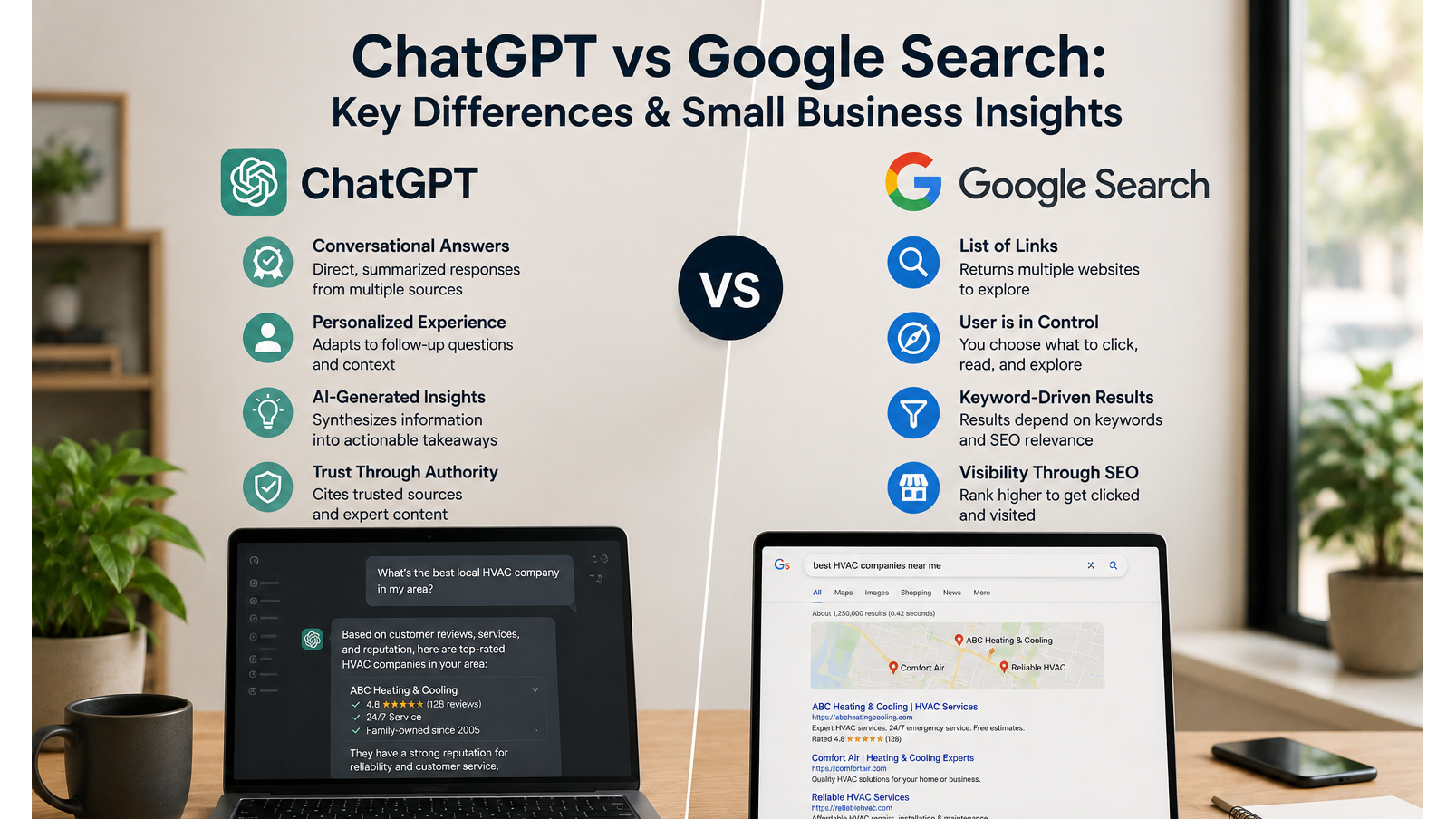
Key Takeaways
- Google’s share of global digital queries has climbed above 90% during 2026, while ChatGPT reached nearly 17.9% of total digital queries, so small businesses need visibility in both places
- Google and ChatGPT work in different ways: one retrieves existing web pages, the other generates answers from patterns learned during training
- Google leads on buying and directions searches, while ChatGPT leads on creative brainstorming and research-style questions, based on intent-based market share research
- A strong Google presence, including a well-maintained Google Business Profile, tends to improve how often a business shows up in ChatGPT’s answers too
- The real risk for small businesses is not choosing the wrong platform, but disappearing from consideration during the research phase before a customer reaches the buying stage
Small business owners used to have one job when getting found online mattered: rank on Google. That job has grown more complicated. Customers now move between search engines and AI chat tools before they ever pick up the phone, and each platform plays a different part in that path.
Google’s 90% vs ChatGPT’s 17% Share
Google’s share of global digital queries has climbed above 90% during 2026, a position built over roughly two and a half decades of refining how it crawls, indexes, and ranks the web. ChatGPT, meanwhile, has reached nearly 17.9% of total digital queries, growth that stands out as one of the fastest shifts search behavior has seen in years. Semrush’s analysis of clickstream data found that people who started using ChatGPT did not cut back on Google; they used both, often in the same research session. Profit Acuity’s breakdown of how ChatGPT and Google Search actually differ covers why that overlap matters for local business owners deciding where to spend limited marketing time.
Two Fundamentally Different Tools
Google Retrieves, ChatGPT Generates
Google works like a librarian with instant recall. It crawls billions of pages, indexes what it finds, and ranks results using hundreds of signals, from page speed to backlink authority. When someone searches, Google hands back a list of existing sources, refreshed constantly as the web changes.
ChatGPT works differently. Rather than pulling live documents, it generates a response based on patterns learned during training on a large volume of text. The result reads more like a conversation than a list of links. ChatGPT Search, deployed in October 2024, added the ability to pull in real-time web data, but the core experience still leans toward building an answer rather than simply ranking sources.
Why This Split Matters for Customers
A customer typing “best plumber near me” into Google gets a map, reviews, and a handful of local listings ready for a click-to-call. The same question asked of ChatGPT produces a built-up answer that may or may not mention a specific business, depending entirely on how well that business is represented across the web. Each approach solves a different problem at a different moment in the customer’s path.
Who Wins Which Searches
Google’s Grip on Buying and Directions
When someone is ready to act, they turn to Google. Intent-based market share research shows Google holds a 90% share of transactional queries and a 93% share of navigational queries. These are the searches tied directly to revenue: booking an appointment, finding store hours, or getting directions to a shop. Google’s map pack, reviews, and pricing snippets are built for exactly this moment, and ChatGPT has no real equivalent for it yet.
ChatGPT’s Edge in Creative and Research Queries
Flip the query type, and the advantage flips too. The same intent-based research found ChatGPT commands a 64% share of generative and creative tasks, compared to Google’s 29% share of that category, things like drafting marketing copy, brainstorming campaign ideas, or working through a business problem conversationally. ChatGPT also holds a 23% share of informational queries, where someone wants an explanation rather than a list of links. Its ability to hold context across a conversation, letting a business owner refine an idea step by step, is something a traditional search engine was never built to do.
Desktop vs Mobile Habits Diverge
Device habits tell their own story. Google’s mobile usage share sits at roughly 63% globally, reflecting quick lookups, driving directions, and price checks done on the go. ChatGPT usage leans the other way: about 62% of sessions happen on desktop compared with 38% on mobile, suggesting its heaviest users are professionals and business owners doing deeper research at a keyboard rather than a phone screen. For a small business, that split means mobile-friendly, fast-loading pages matter for catching Google searchers in the moment, while longer, more detailed content pays off with the desktop-based research crowd more likely to be using ChatGPT.
Getting Your Business Noticed by Both
Ranking on Google Through SEO Fundamentals
Visibility on Google is earned the traditional way: a healthy Google Business Profile, consistent reviews, accurate business hours, and content that answers real customer questions. A business with dozens of genuine five-star reviews and a fully filled-out profile will usually outperform a competitor with a flashier website but a neglected local listing.
Earning a Mention Inside ChatGPT Answers
There is no ranking dashboard for ChatGPT the way there is for Google. Instead, ChatGPT tends to surface businesses that show up often and consistently across authoritative sources, review platforms, directories, and well-structured websites that clearly answer common questions. A comparative analysis by Status Labs, testing 150 queries between September and October 2024, found ChatGPT returned accurate business facts about 76% of the time compared with a 94% accuracy rate for Google when linking to official sources. Profit Acuity notes that a business’s Google SEO presence directly influences whether ChatGPT ends up mentioning it, since ChatGPT Search often pulls from the same credible sources Google already values. Strong, consistent citations across the web tend to help visibility on both platforms at once rather than requiring two separate strategies.
Choosing Where to Focus First
When Local Intent Points to Google
A contractor, salon, or restaurant depending on foot traffic and immediate purchase intent should treat Google as the priority. Consistent business information across directories, prompt responses to reviews, and location-specific content deliver the clearest return for businesses in this category.
When Research Cycles Favor ChatGPT
Businesses selling consulting, coaching, or anything with a longer decision process benefit more from showing up during the research phase. A prospective client might ask ChatGPT a broad question about their problem before ever searching for a specific provider on Google. Detailed, question-answering content that gets cited and referenced elsewhere online improves the odds of appearing in that early conversation.
The Real Risk Isn’t Which Platform Wins
The bigger issue for small businesses has little to do with picking a winner between Google and ChatGPT. Customers are increasingly forming opinions and narrowing their options during AI-assisted research, often before ever reaching a business’s website or Google listing. A business that ignores this earlier stage risks getting quietly eliminated from consideration long before the moment of purchase. Building genuine credibility through reviews, clear content, and consistent information across the web protects against that risk far better than chasing one platform at the expense of the other.
For a clearer sense of where a marketing budget should actually go, small business owners can start with a closer look at small business SEO strategy built around how customers really search today.
Profit Acuity
+1 877 624 1229
Concord Drive
Center Valley
PA
18034
United States


