The Business Research Company’s Discount Department Stores Global Market Report 2026 – Market Size, Trends, And Forecast 2026-2035
LONDON, GREATER LONDON , UNITED KINGDOM, October 27, 2026 /EINPresswire.com/ — The discount department stores market is rapidly evolving, driven by shifting consumer behaviors and technological advancements. As affordability and convenience become more critical for shoppers worldwide, these stores are adapting through digital integration and expanded product offerings to meet growing demand. Let’s explore the market’s size, key drivers, leading players, and emerging trends shaping its future.
Projected Market Size and Growth Outlook for Discount Department Stores
The discount department stores market is expected to surpass $756 billion by 2030. This segment will represent close to 1% of the broader Retail and Wholesale industry’s total valuation, which is projected to reach $124,634 billion by that year. The market’s compound annual growth rate (CAGR) is forecasted at 9% through 2030, reflecting strong and steady expansion fueled by consumer demand for budget-friendly shopping options.
Request A Free Sample Of The Discount Department Stores Market Report
https://thebusinessresearchcompany.com/sample_request?id=18336&type=smp&name=Discount%20Department%20Stores%20Market%20Report%202026&utm_source=EINPresswire&utm_medium=Paid&utm_campaign=Oct_PR
North America’s Dominant Role in Discount Department Stores
By 2030, North America is set to remain the largest regional market, reaching $265 billion, up from $198 billion in 2025, with a CAGR of 6%. This growth is supported by established discount retail chains in the United States and Canada, a consumer preference for value-oriented shopping, broader adoption of omnichannel retail strategies, expansion of private-label products, and continuous investments in supply chain efficiency. The region’s shoppers increasingly seek affordable goods across various categories, reinforcing the market’s strength.
The USA’s Position as the Largest Country Market by 2030
The United States alone is projected to lead the discount department stores market globally in 2030, with a value of $237 billion, up from $176 billion in 2025, maintaining a 6% CAGR. This growth stems from a vast network of discount stores, high consumer spending on everyday essentials and general merchandise, increasing use of digital shopping platforms, demand for convenient retail formats, ongoing store modernization efforts, and competitive pricing strategies adopted by major retailers to attract cost-conscious buyers.
Access The Detailed Discount Department Stores Market Report Here
https://thebusinessresearchcompany.com/report/discount-department-stores-global-market-report?utm_source=EINPresswire&utm_medium=Paid&utm_campaign=Oct_PR
Rising Consumer Price Sensitivity Fuels Market Growth
One of the principal factors propelling the discount department stores market is consumers’ heightened sensitivity to price. Economic uncertainties, inflation, and evolving household budgets are driving shoppers toward affordable alternatives. Discount department stores offer competitive pricing on groceries, apparel, household goods, and personal care products. Retailers respond by optimizing pricing strategies and product assortments to remain accessible and retain customer loyalty. This influence is expected to contribute roughly 2.0% annual growth to the market.
Expansion of Organized Retail in Emerging Economies
Another important growth driver is the rise of organized retail in developing markets. Urbanization, improved retail infrastructure, and the spread of modern shopping formats are creating new opportunities for discount retailers. Organized chains often manage inventory more efficiently, maintain robust supply networks, and provide broader product availability. Consumer preference for structured, convenient shopping environments encourages store expansion in these regions, contributing about 1.5% annual growth to the sector.
The Impact of Promotional Campaigns on Market Dynamics
Promotional activities such as seasonal sales, loyalty programs, bundled offers, cashback incentives, and targeted discounts are increasingly used to attract price-sensitive shoppers. These campaigns boost customer engagement, increase purchase frequency, and enhance brand visibility. As competition intensifies, such marketing tactics are critical to driving store traffic and sales, adding approximately 1.3% to annual market growth.
General Merchandise and Specialty Products Drive Market Value Gains
The market’s largest growth opportunities lie within general merchandise and specialty products. Between 2025 and 2030, these categories are expected to contribute more than $253 billion in new market value, with general merchandise increasing by $154 billion and specialty products by $99 billion. The expansion reflects consumer demand for affordable products, greater adoption of value-based retail formats, growth in organized retail networks, and improvements in product availability and customer-focused retail approaches.
Dominance of General Merchandise in Discount Department Stores
General merchandise accounts for the majority share of the discount department stores market, representing 64% or $481 billion of the total market in 2030. This segment benefits from offering a broad array of affordable products under one roof, appealing to shoppers seeking convenience. Large-format store growth, emphasis on inventory management, product variety, and investments in customer-centric retail experiences across physical and online channels further fuel its leading position.
Product and Distribution Segmentation Within the Market
The discount department stores market categorizes products into clothing, electronics, groceries, and household goods. Distribution channels are divided into offline and online formats, reflecting the growing importance of e-commerce alongside traditional retail outlets.
How Store Modernization and Digital Technology Are Transforming the Market
Modernization efforts paired with digital integration are reshaping the shopping experience in discount department stores. These changes are enhancing customer convenience, streamlining operations, and linking physical stores with online platforms for a seamless omnichannel approach. For instance, Walmart Inc. announced in April 2026 a significant investment program involving over 650 store remodels and approximately 20 new store openings through early 2027. Enhanced store layouts, expanded pickup and delivery services, upgraded digital interfaces, and better in-store navigation are set to improve both customer engagement and operational efficiency.
Market Fragmentation and Competitive Landscape Overview
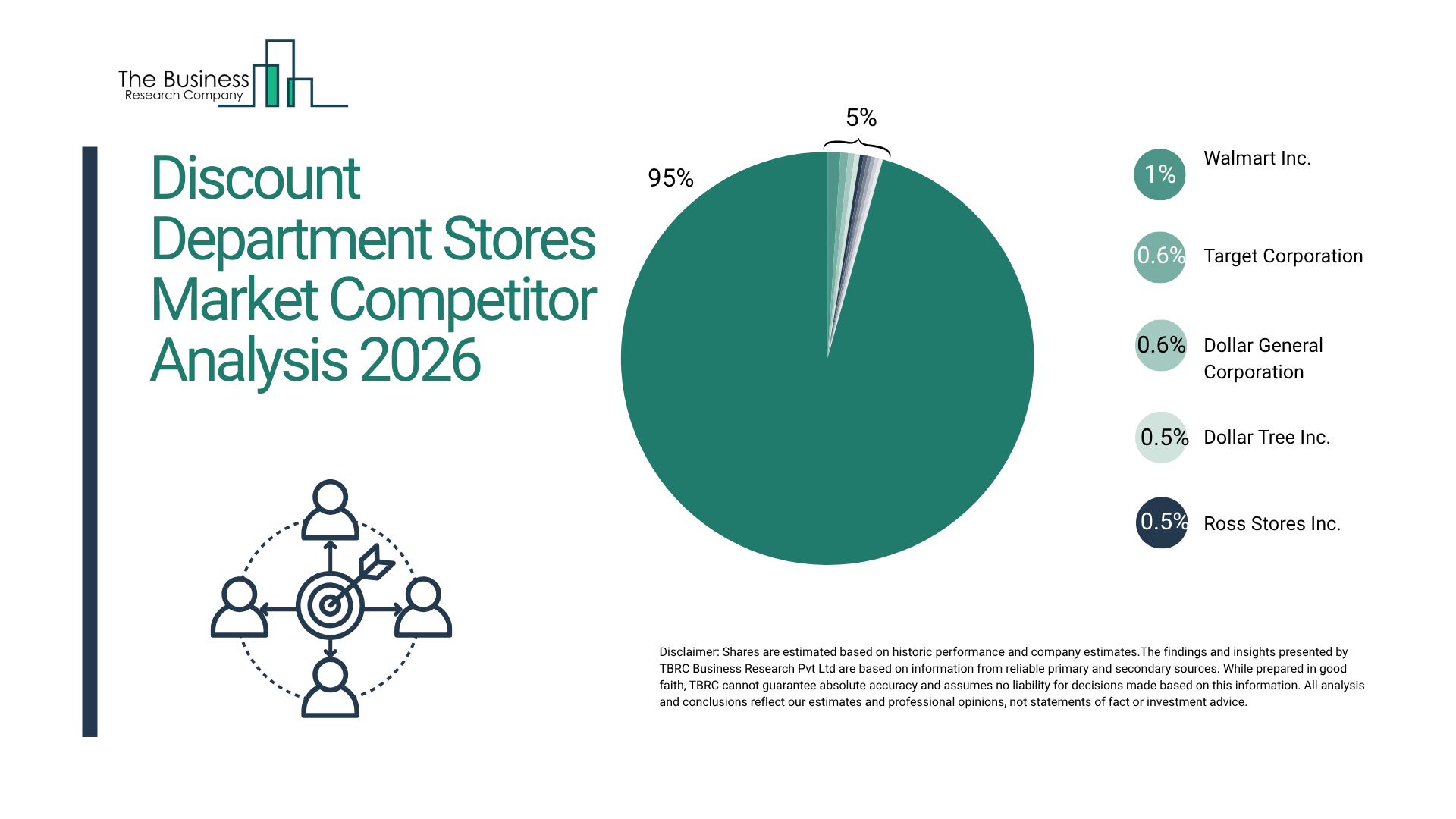
The discount department stores market is highly fragmented, with the top 10 players holding only 5% of total market revenue as of 2025. This low concentration is due to relatively low barriers to entry, varied consumer buying habits, extensive requirements for store networks, fierce pricing competition, and the need for robust inventory and distribution management. Leading companies maintain their positions through broad product assortments, large-scale operations, strong supplier relationships, recognizable brands, and ongoing advancements in digital commerce and customer engagement.
Major Market Players and Their Share of Revenue in 2025
Key players in 2025 include Walmart Inc., Target Corporation, Dollar General Corporation, Dollar Tree Inc., Ross Stores Inc., Burlington Stores Inc., TJX Companies Inc., Big Lots Inc., Meijer Inc., and Carrefour SA. Each of the top four companies holds about a 1% share of the market, while others range from 0.3% to 0.5%, collectively shaping competitive dynamics.
Strategies Companies Use to Stay Ahead in the Market
Retailers are pursuing several strategic initiatives to maintain their market edge. These include expanding private label brands to strengthen value offerings, utilizing artificial intelligence for better inventory management and demand forecasting, developing smaller store formats to increase accessibility, adopting automated checkout systems to enhance convenience, and investing in omnichannel capabilities to blend physical and digital retail experiences.
Walmart Inc.’s Leading Role in the Discount Department Stores Sector
According to The Business Research Company, Walmart Inc. topped the global sales chart in 2025 with a 1% share of the market. Its discount retail and supercenter stores play a critical role by delivering affordability, variety, and convenience across groceries, apparel, household goods, electronics, and general merchandise to a broad consumer base worldwide.
Key Industry Participants Beyond Retailers
The discount department stores ecosystem also includes significant raw material suppliers such as Procter & Gamble, Unilever PLC, The Coca-Cola Company, PepsiCo Inc., Nestlé S.A., Kimberly-Clark Corporation, Colgate-Palmolive Company, and others. Major wholesalers and distributors like McLane Company Inc., C&S Wholesale Grocers LLC, KeHE Distributors LLC, and more play vital roles in the supply chain.
Typical End Users in the Discount Department Stores Market
End consumers span a diverse range of groups, including individual shoppers, households, small businesses, educational institutions, hospitality operators, healthcare facilities, corporate offices, government entities, non-profit organizations, retail resellers, restaurants and foodservice operators, facility management companies, construction firms, event organizers, fitness centers, beauty and personal care providers, automotive service centers, community groups, professional services, and travel and tourism businesses.
What’s included in our 2026 market reports:
• Market attractiveness scoring and analysis
• Total addressable market (TAM) analysis
• Company scoring matrix graphics and tables
• Excel-based forecasting dashboards
• Market hotspots infographics
• Key technologies and future trend analysis
• Updated graphics and tables
Learn More About The Business Research Company
The Business Research Company (www.thebusinessresearchcompany.com) is a leading market intelligence firm renowned for its expertise in company, market, and consumer research. We have published over 30,000+ reports across 27 industries and 60+ geographies. Our research is powered by 1,500,000 datasets, extensive secondary research, and exclusive insights from interviews with industry leaders.
We provide continuous and custom research services, offering a range of specialized packages tailored to your needs, including Market Entry Research Package, Competitor Tracking Package, Supplier & Distributor Package and much more.
Disclaimer: Please note that the findings, conclusions and recommendations that TBRC Business Research Pvt Ltd delivers are based on information gathered in good faith from both primary and secondary sources, whose accuracy we are not always in a position to guarantee. As such TBRC Business Research Pvt Ltd can accept no liability whatever for actions taken based on any information that may subsequently prove to be incorrect. Analysis and findings included in TBRC reports and presentations are our estimates, opinions and are not intended as statements of fact or investment guidance.
Contact Us:
The Business Research Company
Americas +1 310-496-7795
Europe +44 7882 955267
Asia & Others +44 7882 955267 & +91 8897263534
Email: marketing@tbrc.info
Follow Us On:
LinkedIn: https://in.linkedin.com/company/the-business-research-company.
Oliver Guirdham
The Business Research Company
+44 7882 955267
info@tbrc.info
Visit us on social media:
LinkedIn
Facebook
X
Legal Disclaimer:
EIN Presswire provides this news content “as is” without warranty of any kind. We do not accept any responsibility or liability
for the accuracy, content, images, videos, licenses, completeness, legality, or reliability of the information contained in this
article. If you have any complaints or copyright issues related to this article, kindly contact the author above.

Media gallery